
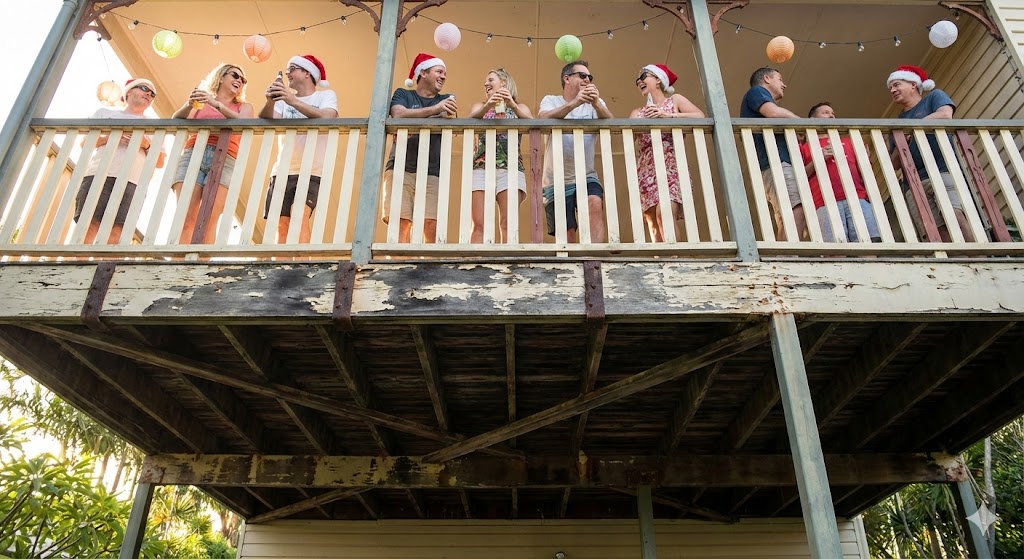
Melbourne Architect warns homeowners to check balcony safety ahead of holiday gatherings: How a simple safety inspection before entertaining could help avoid tragedy this summer

As Australians get ready to celebrate the holiday season with family, friends and colleagues, prominent Melbourne architect Robert Caulfield is urging homeowners to check the safety of their balconies.
“This is a terrific time of year, with the warm weather coaxing people to hold long lunches and big get-togethers outside. With so many celebrations being held at homes and holiday houses with balconies, past years reveal a serious pattern of balcony collapses occurring at this time of year, often resulting in serious injuries and, in some cases, deaths. The risk is high, especially for older timber balconies that haven’t been properly maintained.”
He advises anyone planning to host gatherings at homes with balconies to take simple but critical precautions to help avoid tragedy this summer.
Mr Caulfield, a past National President of the Australian Institute of Architects, asserts that many Australians underestimate how rapidly balconies deteriorate and how dangerous they can become when overloaded. Irrespective of whether a balcony has been safe in the past, he warns that it may not be safe now. “Timber balconies, in particular, will deteriorate every year.”
“Most structural failures occur because the balcony has been badly built or has degraded over time. For many, alarm bells only go off when swaying is noticeable. Movement underfoot is not something to ignore, as it can mean the joints have loosened or the timber has started to split,” Mr Caulfield says.
Overloading a balcony with excessive or concentrated weight can increase the risk of collapse for even newer structures. Furniture and decorations should be lightweight, kept to a minimum and evenly distributed. “Balconies are not designed to take very heavy loads,” Mr Caulfield says. “Never get people to huddle together in large groups on a balcony for photos. The combined weight of 20 people gathered on one end of a balcony is roughly equivalent to that of a car.”
Seaside Danger
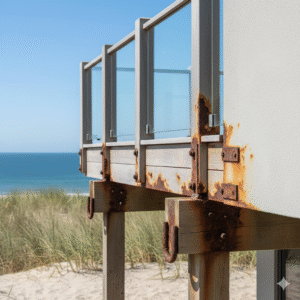
Holiday home balconies, especially those along the coast, are particularly susceptible due to harsh winds and salt air accelerating decay. Mr Caulfield says danger can go undetected, as these homes are “not used all that often and people don’t necessarily check these things.”
The collapse of a balcony at an Anglesea holiday home over the Australia Day weekend earlier this year occurred while a group of eight people were eating lunch on the balcony. The balcony’s sudden failure resulted in the group, along with a dog, falling approximately 2.5 metres. While no life-threatening injuries were reported, the temporary entrapment of three individuals beneath the collapsed structure underscores the seriousness of these incidents.
Reducing Risk
Mr Caulfield urges homeowners to take precautions to reduce the chance of balcony failure before hosting guests this holiday season,
- Detect, repair, maintain
Before using your balcony, undertake Mr Caulfield’s DIY balcony inspection. A few warning signs are easy to check for and can be detected before risk occurs. When detected, issues should be addressed immediately. Decayed timber and corroded metal should be replaced and cracked concrete should be patched promptly. Resealing or repainting can help maintain timber balconies by keeping moisture out. Similarly, a waterproof membrane can protect concrete balconies.
- Respect the limit and avoid heavy objects
Never exceed the intended load capacity of your balcony. If you are unaware of its load rating, assume conservatively. Consulting a structural engineer can provide a safe limit. Avoid placing heavy outdoor furniture, ornaments, pot plants and barbecues as these can add excessive load.
- Refrain from overcrowding and spread out
Restrict the number of people on the balcony during gatherings and discourage people from bunching together for group photos. Suggest people spread out or take photos elsewhere.
- If in doubt, just don’t use it
Don’t use the balcony if you are unsure. “Even if you’ve used it safely in the past, it may not be safe now,” Mr Caulfield says. Structural weakening can be discreet.
DIY Balcony Inspection Checklist:
- Feel for movement underfoot
Detectable swaying or bouncing when walking across the balcony can signal deteriorated joints.
- Look for signs of soft, darkened or crumbling timber
Discolouration, cracks and sponginess on timber posts, joists and beams signal rot and preface structural decline. Pay careful attention to the underside of the balcony.
- Examine for bowing and splitting
Sagging, curving and splitting timber decking can indicate the structure is under stress.
- Check for corroded connections
Rusted bolts, brackets and fixings, particularly where the balcony attaches to the house, indicate weakening in this critical connection.
If any of the signs are detected, homeowners should avoid placing any additional load on the balcony and arrange a professional inspection by an architect, engineer or building surveyor.
A five-minute inspection before Christmas can make all the difference.